Stress, Cortisol & Hair Loss
Updated: Jul 28
When the nervous system takes the lead

Hair loss doesn't only respond to hormones and nutrients — it also responds to how safe your body feels.
Your nervous system is constantly gathering information about your environment — stress, sleep, trauma, illness, overwork — and deciding where energy should go. When the body perceives threat or overload, hair growth quickly moves down the priority list.
What many people don't realize: stress isn't only something you feel emotionally. The brain also registers internal stressors — nutrient deficiencies, blood sugar instability, inflammation, hormonal imbalance, poor sleep — even when you don't consciously feel stressed.
To the nervous system, stress is stress, and the physiological response is the same. This is why stress-related hair loss often feels confusing, delayed, and emotionally charged.
Understanding the nervous system's two modes
The autonomic nervous system regulates heart rate, digestion, hormone signaling, immune response, and tissue repair, through two branches: the sympathetic ("fight or flight") and the parasympathetic ("rest, digest, and heal").
When it's balanced, the body can digest food, absorb nutrients, regulate hormones, repair tissue, and support healthy hair growth. Think of it like a dimmer switch, not an on/off button — when fight-or-flight stays turned up too high for too long, the body can't fully access rest and repair. Hair growth needs that dimmer turned down so the body feels safe enough to invest in growth again.
Why stress-related hair loss is often delayed
Hair shedding often shows up 3-4 months after a major stressor — illness or surgery, postpartum recovery, emotional trauma or grief, chronic overwork, sleep deprivation, or a big life transition. By the time shedding starts, the stress may feel "over" — but the nervous system is still recalibrating. This pattern (telogen effluvium) is one of the most common causes of diffuse shedding in women.

Cortisol's role
Cortisol isn't a bad hormone — it's essential for survival. But chronically elevated cortisol creates an environment that's hostile to hair growth: it can suppress progesterone, disrupt estrogen balance, impair thyroid hormone conversion, worsen insulin resistance, and increase inflammation around follicles. Over time, this pushes follicles into resting mode and shortens the growth phase.
The thyroid-stress-hair connection
Stress affects the thyroid too — reducing T4-to-T3 conversion, increasing reverse T3, and dulling cellular thyroid signaling. Even with a "normal" TSH, follicles may not get the metabolic signals they need for growth. This is why stress-related hair loss often overlaps with fatigue, cold intolerance, brain fog, and slow recovery.
How I assess stress-related hair loss
When stress is a suspected driver, I look at cortisol rhythm, a full thyroid panel, blood sugar stability, inflammatory patterns, sleep quality, and life stress history. Hair loss rarely comes from stress alone — but stress often amplifies every other imbalance.
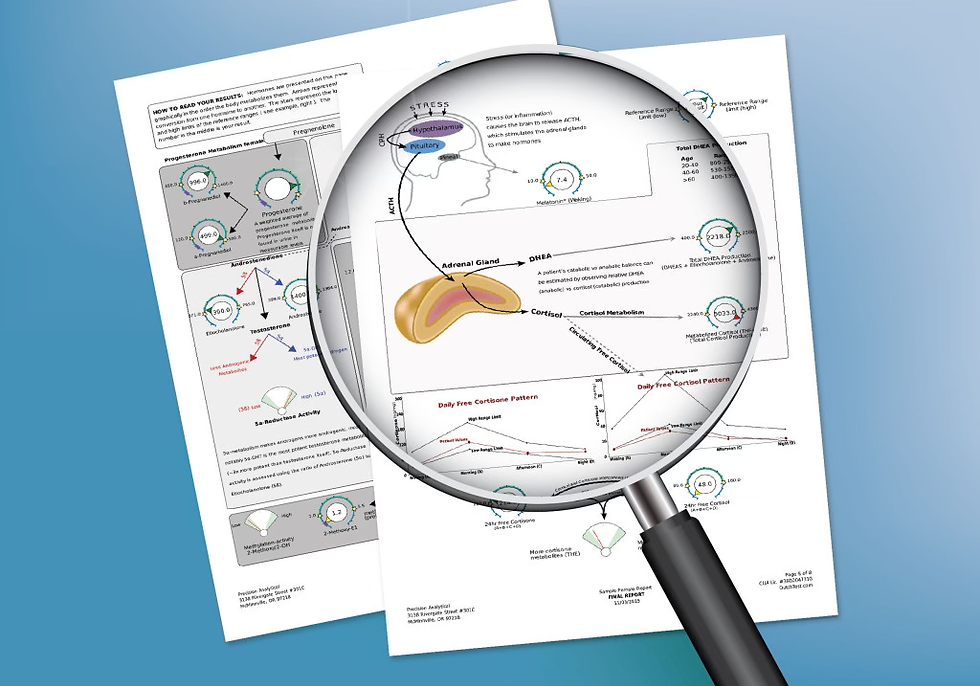
I also utilize the adrenal panel from Precision Analytical, four point daily measurements mapping your active and inactive stress hormone levels throughout the day.
The more we know about how your body is responding to stress, the better we can support it.
Supporting the nervous system = supporting hair
Hair regrowth doesn't begin when stress disappears — it begins when the nervous system feels safe enough to rebuild. That often means restoring circadian rhythm, supporting blood sugar balance, a heathy cortisol response, addressing nutrient depletion, improving sleep, calming inflammation, and rebuilding emotional reserves.
Hair loss is rarely just about hair. It's about hormones, nutrients, metabolism — and the nervous system that governs them all.
Let's Talk
Have you noticed hair shedding after a stressful season — even months later?
I personally had significant hair loss after having COVID. That illness created the perfect storm of every hair-loss offender at once — stress, inflammation, nutrient depletion, and hormonal disruption. My hair didn't stand a chance.
If this sounds familiar, you're not alone.
Next Step: Work With Me If you're ready to get to the root of what's driving your hair loss, let's talk. Book a free discovery call and we'll map out what's really going on.
Book a Free 30 minute Discovery Call .


Comments